Tort reform strips consumers of rights
Read our blog posts on the perils of tort reform here, here, and here.
The right to trial by jury is a Constitutional right. It is guaranteed by the 7th Amendment in the federal Constitution as part of the Bill of Rights. Other parts of the Bill of Rights contain the First Amendment right to freedom of religion, speech, assembly, the press, and the right to petition the government for redress of wrongs; as well as the 2nd Amendment right to bear arms. The 7th Amendment says:

"In Suits at common law, where the value in controversy shall exceed twenty dollars, the right of trial by jury shall be preserved, and no fact tried by a jury, shall be otherwise re-examined in any Court of the United States, than according to the rules of the common law."
Sometimes state law controls when a person is entitled to a trial by jury. As a Special Associate Justice on the Arkansas Supreme Court, Don wrote an opinion reaffirming the Arkansas Constitution’s guarantee of the right to trial by jury on a lender-liability claim whereby a bank tried to use a technicality to invalidate this fundamental right. The right to a trial by jury in the Arkansas Constitution is broader than the federal Constitution, stating as follows:
“The right of trial by jury shall remain inviolate, and shall extend to all cases at law, without regard to the amount in controversy…” Ark. Const. Art. 2, § 7.
"The Supreme Court shall prescribe the rules of pleading, practice and procedure for all courts; provided these rules shall not abridge, enlarge or modify any substantive right and shall preserve the right of trial by jury as declared in this Constitution." Ark. Const. Amend. 80, § 3.
"I consider trial by jury as the only anchor yet imagined by man by which a government can be held to the principles of its constitution."
--Thomas Jefferson
"If it [jury power] is not law, it is better than law, it ought to be law, and will always be law wherever justice prevails."
--Ben Franklin
"The friends and adversaries of the plan of the [Constitutional] convention, if they agree on nothing else, concur at least in the value they set upon the trial by jury; or if there is any difference between them it consists of this: the former regard it as a valuable safeguard to liberty, the latter represent it as the very palladium of free government."
--Alexander Hamilton
The clear mandate in the 7th Amendment, given to us by our Founding Fathers is under assault. Insurance companies, big business, and politicians blame “runaway juries” for all sorts of public ills. These folks advocate for “tort reform,” which is a technical word for two concepts: (1) limiting the types of lawsuits that can be filed in the first place, and (2) placing a cap on the amount a judge can allow in a judgment against a wrongdoer, regardless of what a jury believes is required to fairly compensate an injured person.
We saw this firsthand in Arkansas in 2003, when tort reformers passed an Act with lots of unintended consequences. It was a poorly-written law, and the court system spent a decade sorting out the constitutional parts from the unconstitutional parts. In 2013, special interest groups financed by the Koch Brothers tried to sneak tort reform through the Arkansas Legislature in the form of SJR5 on two hours’ notice during a severe weather outbreak across the state. Lawyers from the Chaney Firm and others around the state dropped everything to attend the committee hearing in opposition to the bill. It was defeated in committee. The vote was close, and it shows that special interest money from the Koch brothers can buy lots of access.
Other similar efforts to change the Arkansas Constitution occurred in 2016 and 2018. In 2016, the Arkansas Supreme Court invalidated a ballot initiative seeking to establish a damages cap for intangible elements of damages because it was vague. In 2018, the Arkansas Supreme Court invalidated a constitutional amendment referred by the General Assembly because the amendment would have made 7 different changes to the Arkansas Constitution under the guise of a single amendment in violation of Ark. Const. Art. 19 § 22’s requirement of only referring 3 amendments to the voters on separate topics.
Tort reformers such as the Koch brothers have spent, literally, billions of dollars in advertising campaigns trying to convince the public that jury awards are out of control. Ask yourself this — How many total runaway jury verdicts can you name? How many in Arkansas? How many involving someone you know, either as a party or on the jury?
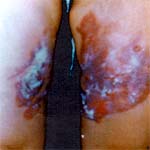
Compare three cases. On one hand is the often-ridiculed McDonald’s hot coffee case. This case is the subject of a documentary named Hot Coffee, which is available on Netflix. We encourage you to watch; we have loaner copies if you don't have Netflix. Look at the image of the elderly woman’s scalded thighs. Isn't it disturbing? There can be little doubt this was an actual, painful, physical injury. The woman’s treatment ultimately required skin grafts. There was evidence at the trial her burns could (and did) happen in as little as two seconds. A simple incident for a passenger in a parked car, a spilled drink, something that everyone has done, led to serious injuries in two seconds. There was evidence McDonald’s knew about hundreds of other burn victims but didn’t take preventive measures to prevent these types of burns. That is needless danger to the public, and it led to serious injuries. So, the jury enforced what it believed was an appropriate punishment that would make McDonald’s change the way it served coffee — 2 days’ worth of McDonald’s coffee sales (which was later reduced by the judge).

On the other hand are two examples. The first is FedEx. FedEx is on the board of the U.S. Chamber of Commerce. The U.S. Chamber is a wealthy lobbying group of major corporations that actively campaigns (1) against the right to bring lawsuits and (2) for other changes in the law that would discriminate against employees. As a large part of their strategy, FedEx and the U.S. Chamber complain about frivolous lawsuits. Hypocrisy seems to know no bounds — This is the same FedEx who filed a federal lawsuit against a man for creating furniture out of FedEx boxes (see photo at right) and putting pictures of that furniture on the Internet. If FedEx is so dead-set against frivolous lawsuits, then why is it filing federal lawsuits against its customers who make furniture out of FedEx boxes?
The other example of “do as I say, not as I do” is one of the same Koch brothers we discussed earlier. Billionaire William Koch sued a California wine distributor for punitive damages, claiming that the bottles of wine he never inspected at an auction were fake. Koch paid $29,500 for one bottle (more than the federal poverty level for a family of 5) and $380,000 (8 times the median U.S. annual income of about $46,000) for two cases. Koch stated, “I absolutely can’t stand being cheated.” Apparently the Koch family’s hypocrisy knows no bounds: their lobbying group American Legislative Exchange Council (ALEC) has spend millions of dollars across the country for decades lobbying for draconian tort reform that would make it harder for ordinary Americans to receive compensation for injuries incurred through no fault of their own. To put this in perspective, for a billionaire, this amount of money is equivalent to $17.48 to someone making the median American income, or about the price of a bottle of wine. Would you sue someone over this amount? If the Koch brothers really hated frivolous lawsuits, would they be doing so?
Incidentally, the Koch brothers made most of their money on oil and have been big proponents of the Keystone XL pipeline — the big brother to the Keystone pipeline that burst in Michigan in 2010 and right here in Arkansas in 2013. It is plainly obvious that these men don’t care about American citizens — otherwise, they’d worry more about the sanctity of the court system and the safety of their pipelines, and less about suing over a bottle of wine.
Insurance companies such as State Farm also support tort reform. Why? The fewer claims that can be brought, and the lower amount of those claims, mean that insurance companies can keep more premium dollars as profits. Take the case of former U.S. Senator Trent Lott, who once defended the insurance industry. After he lost a house in Hurricane Katrina, State Farm denied his claim. Senator Lott changed his mind and decided it was the insurance industry that was in need of reform.
Many times, the law can’t put people back where they were before they were hurt. So, the law provides that money should compensate injury victims to fix things the best they can be fixed, to help what can’t be fixed, and to make up for what went wrong. In some cases, where someone needlessly endangers the public, our law provides for “punitive damages” in order to deter future bad behavior. Our Founding Fathers realized that the best judges of how to fix, help, make up for, and punish (where appropriate) the wrongs of others was a committee of twelve citizens that had no interest in the case. Juries are, literally, the conscience of our communities. Juries decide what the rules are, and what value those rules have. You can see for yourself by watching the juror orientation video from the State of Arkansas (the federal version is available here):
Tort reform really comes down to who you would rather decide the value of our society’s rules: everyday people from your own community, or multinational companies? At the Chaney Law Firm, we fight every day to preserve the one right that preserves all others: the right to a trial by jury.

