CHANEY LAW FIRM BLOG

Subscribe to our Blog

Nathan receives award from Arkansas Trial Lawyers Association

The Arkansas Trial Lawyers Association (ATLA) held its annual convention in Little Rock last weekend, and Nathan received ATLA's award for Outstanding Member of the Young Lawyers Division.

Nathan has been a member of ATLA since becoming a licensed attorney in 2004. However, Nathan's history with the organization is much older. Don has been a member of ATLA for three decades, and Nathan attended many an annual meeting in Eureka Springs with his father.

We are excited and proud to have ATLA award-winning trial lawyers within our ranks, as ATLA's mission statement coincides with our own:

ATLA has become the state’s largest and most active voluntary statewide legal organization representing, educating and developing Arkansas’ trial bar. Our members are attorneys dedicated to protecting the health and safety of Arkansas families, to enhancing consumer protections and to preserving each and every citizen's right to trial by jury and access to the courts.

For more information, please visit ATLA's website.

El Dorado man earns fishing yo-yo patent

A client of mine from El Dorado recently earned a patent on an improvement he invented for fishing yo-yos. (For those of you unfamiliar with yo-yos, check out this ESPN article, which was cited in the patent application to educate the patent examiner).

The new yo-yo adds a battery and a switch on the back of the yo-yo. The front part of the yo-yo is a spool that has an integrated trigger. The yo-yo and switch are baited and set. When a fish strikes, the spool begins turning to reel in the fish. The turning action of the spool also turns the trigger, which trips the switch and signals the fisherman that he has caught a fish. The switch is most often a light, but can also be a radio signal.

An optional feature is to have a light shining down on the water when the yo-yo is set. This has two advantages: (1) the light attracts bugs, which attract small fish, which attract bigger fish; and (2) the fisherman can see where his yo-yos are at night. When a fish strikes, the switch turns out the light shining on the water and activates another, different-colored light to alert the fisherman.

Congratulations to Mr. Carelock on his new patent!

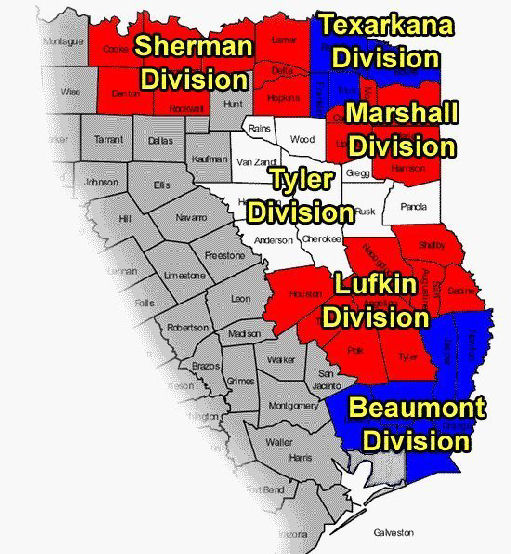
Patent Rocket Docket stays in the Eastern District of Texas

In 2010, the Eastern District of Texas remained the undisputed Rocket Docket for patent cases. According to a recent article, 299 patent cases were filed in the E.D. Tex. in 2010. That’s 44 more cases than the next most popular district in Delaware. Even more stunning, however, is the number of defendants in the E.D. Tex.: nearly 4,000, compared with under 1,000 for the next most popular district.

The E.D. Tex. remains a popular district because the docket moves quickly (hence the nickname) and because the judges are perceived as familiar with patent cases. In litigation, plaintiffs generally want to move quickly, while defendants wish to slow down the process. Motions to transfer venue are a way to slow down the process by (1) filing the motion in the first place, and (2) transferring the case to a slower, less patent-savvy district court.

The Federal Circuit Court of Appeals, which hears all patent appeals, continues to review many cases involving requests for transfer of venue. Some of those cases have attempted to make it easier for Defendants to secure a transfer of venue to a more convenient location. Accordingly, it remains to be seen whether the E.D. Tex. will continue to be the nation’s Rocket Docket for patent cases.

Patent pendency dashboard

pendency.jpg

Last fall, the U.S. Patent & Trademark Office (“USPTO”) unveiled its Data Visualization Center, which is a real-time reporting tool showing the USPTO’s performance in examining patent applications.

The Patent Dashboard feature shows several metrics for pending patent applications. The USPTO currently issues its first substantive action on the average new patent application 25.3 months after the filing date, and is currently issuing patents a little less than 3 years after the filing date.

Over the last several months, the USPTO has added staff and made a concerted effort to reduce the application backlog. The result has been a reduction in the total pendency time for new applications.

These figures are great for people (especially new clients) who are thinking about filing a new patent application. Once an application is filed, the USPTO will provide an estimate of time to the first office action for that particular application. Clients who want to know this information can call and ask for this estimate, which we can retrieve quickly through the USPTO’s Private PAIR system.