CHANEY LAW FIRM BLOG

Subscribe to our Blog

During election season, think about all your rights - including the 7th amendment

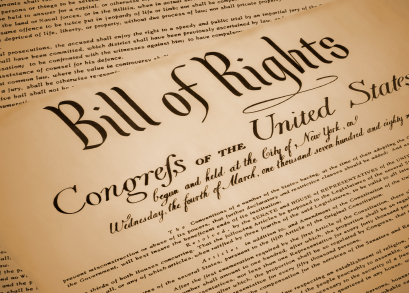
As election season ramps up to full gear, we hear political debate about many of our rights. Most folks know where many of our rights as U.S. citizens come from — the Bill of Rights, which are the first 10 amendments to the U.S. Constitution.

Most of us are familiar with the 1st Amendment, which deals with freedom of religion, of speech, and of the press. In times when children are murdered across the globe for what they say and wear, most of us realize this is our most fundamental freedom. Maybe that's why it came first.

Most of us in Arkansas believe in a strong 2nd Amendment, which is the right to bear arms.

The 7th Amendment is in the Bill of Rights. It says:

In suits at common law, where the value in controversy shall exceed twenty dollars, the right of trial by jury shall be preserved, and no fact tried by a jury, shall be otherwise reexamined in any court of the United States, than according to the rules of the common law.

There is no doubt that the 7th Amendment guarantees the right to a trial by jury. It also says that factual findings by juries cannot be second-guessed by courts. (Similarly, Article 2, Section 7 of the Arkansas Constitution guarantees Arkansans the right to a trial by jury.)

What is the role of a jury? It is to listen to the facts when parties have a dispute, to decide which facts to believe and which to disbelieve, and to judge what is the right solution to the dispute between the parties. A jury is the way common citizens can have their peers hear all the facts and resolve disputes. Our jury system is a cornerstone of our democracy, and it is what separates us from other countries around the world.  

Why is this important? Because the 7th Amendment is under attack. Some special interest groups, such as the Koch Brothers, are hard at work lobbying Arkansas lawmakers to place limits on how juries can decide cases. This is called "tort reform," and it is designed to take power out of the hands of ordinary Americans. Instead of having ordinary citizens decide disputes, tort reform laws would place artificial boundaries on how juries can decide cases.

This is bad for America.

In our neighboring state of Texas, even Fox News has recognized that tort reform has unintended consequences (we've previously reported on this here and here). Doctor groups and former Republican senators, among others, have come out against tort reform because it takes power away from the people. The BP oil spill in 2010 shows that liability caps remove incentives for companies to put safety first.

At its core, the jury system is about ordinary citizens holding others responsible when they make mistakes or intentionally break the law. It is about justice in an individual case — not a one-size-fits-all rule imposed by government. Any attack on the jury system is an attack on personal responsibility — if the at-fault party can't be held responsible, then too often the burden falls on the taxpayer to foot the bill. 

All 10 Amendments in the Bill of Rights are important, not just 1 or 2. All 10. During this election season, please remind your lawmakers that you want to conserve the jury system in Arkansas, just the way it is. 

Get an early start on 2014 wet/dry elections

With election season gearing up, we’re all hearing about a few counties in Arkansas who have the wet/dry issue on the ballot. I’ve heard from folks in several counties who are thinking, “Why can’t that be me?”

If you’re thinking about making a wet/dry election (called a “local option” election under Arkansas law) happen in your county, here’s an overview of the process and how I can help.

READ THIS FIRST!

The most important thing about a successful local option election is that it requires a coordinated and sustained effort by a committed local group. Without a core group of volunteers willing to advance a grassroots effort, any local option election is destined to fail. I can assist with all phases of the process, but at the end of the day the local presence will determine whether the initiative makes the ballot.

The second most important thing about a local option election is that exact compliance with Arkansas election law is required during the petition phase. There are many Arkansas cases where substantial compliance was not good enough. Most of my initial efforts are designed to educate the core group on what it takes to achieve compliance with Arkansas election law, because the petition phase is typically the longest part of a local option campaign.

CAMPAIGN ORGANIZATION

I break a local option campaign down into five major categories: (1) accounting; (2) fundraising; (3) public relations; (4) canvassing; and (5) legal. Each will be discussed in more detail below. Ideally, a ballot question committee (“BQC”), which is the legal entity required for advancing a local option election, will be made up of an executive committee that has a chairman, a document coordinator, and a head of each of the five divisions discussed below.

Accounting:

The accounting division handles initial registration of the BQC, tax identification numbers, and bank accounts. Monthly reports are required of donations, loans, and expenditures during the campaign, and a final report must be submitted once the election is over. Typically during an election cycle, I assist with setting up the BQC and fielding questions concerning reporting requirements for certain types of contributions and loans.

Fundraising:

The fundraising division solicits donations, keeps track of income, and turns accurate records over to the accounting division. The main purpose for my involvement in the fundraising division is to ensure that reporting requirements are met. Some reporting requirements for BQCs are slightly different than ordinary campaign finance laws.

Public Relations:

The public relations division is responsible for advertising and turning out the vote. My involvement in PR work for local option campaigns has varied widely, but at its apex I extensively researched wet/dry statistics; created mail pieces, flyers, and newspaper ads; wrote op-ed pieces; ran social media campaigns; and gave newspaper interviews about the election process.

Canvassing:

The canvassing division involves the actual collection of registered voter signatures. It involves training members of the BQC to both collect signatures and train others how to collect signatures in compliance with Arkansas election law. Alternatively, a BQC may elect to hire an outside firm to gather signatures for a fee. This division is responsible for knowing who is a registered voter, whether they have signed the petition, and whether each signature should count towards a rolling tally.

Because I am a lawyer and cannot be a witness to any case that may arise as a result of the petition process, my involvement in this phase is limited to the initial training session and then fielding questions from canvassers during the petition drive.

Legal:

The legal division is responsible for drafting the actual petition language, getting it approved by the local Board of Election Commissioners, and certifying it before circulation. This division is also responsible for the initial training sessions for canvassers. It is also a good idea for the legal division to periodically check for updates to relevant election laws. Usually I field questions during the petition drive over electioneering issues. Examples of questions that I have fielded before are:

  • Can I gather petition signatures in the church parking lot during the primary election as long as I’m 100 feet from the door?
  • Does a signature count if the person dies?
  • How many signatures do we need?

Invariably, different issues arise during each election. I understand that assisting with elections requires me to be both knowledgeable and responsive so that my clients can get quick answers to time-sensitive questions.

 WHAT I PROVIDE

Much of my work on local option elections involves preparing the BQC to gather signatures and conduct the campaign in compliance with Arkansas law. I provide the actual initiative petition; organizational charts; detailed instructions for the document coordinator, canvasser trainers, and canvassers; example ads, postcards, and flyers; report forms for the Arkansas Ethics Commission; and relevant laws, regulations, and rules governing local option elections. I use these materials to train the people who will gather signatures and who will train others to gather signatures themselves. All this occurs before the first signature is signed onto the petition.

My involvement afterwards becomes that of campaign consultant. I am as involved as your BQC wants me to be. That can range from fielding the occasional legal question to being actively involved in preparing campaign materials and running social media and other advertising campaigns.

Litigation often arises during local option campaigns. It is my goal to avoid litigation by putting in the preparatory work so that the petition drive is performed correctly and is insulated from a legal challenge. In the event the petition is challenged, however, I am an experienced trial attorney with a strong handle on the evidentiary and legal requirements necessary to win a legal challenge to my clients’ petitions.

If you’re interested in organizing a BQC in your county, please give me a call. I’d be happy to help.

New study shows pain meds don't work for 27% of whiplash patients

A new study published in the Scandinavian Journal of Pain explored the effectiveness of pain medications for whiplash patients with chronic pain. The patients were administered morphine or ketamine (both powerful pain drugs). 27% of the patients were classified as non-responders, meaning that the powerful pain drugs were ineffective in relieving chronic whiplash pain. The article "stresses the importance of individualizing the assessment and treatment of subjects with chronic whiplash-associated disorders."

Whiplash treatment isn't a one-size-fits-all approach. Injuries can be painful, permanent, and progressive, and treatments need to be tailored to what works for individual patients. A combination of family doctors, radiologists, neurologists, osteopaths, chiropractors, physical therapists, and massage therapists, among others, is not unusual for patients seeking relief from chronic whiplash pain.

The full citation for the article is M. Persson, J. Sorensen, B. Gerdle, Whiplash Associated Disorders (WAD): Resposnes to pharmacological challenges and psychometric tests, Scandinavian Journal of Pain 3(2012) 151-163.

Nathan wins pro bono bench trial for disabled veteran

A local disabled veteran was sued by a lending institution over a loan made several years ago. The debt collector hired by the lending institution added a whole bunch of fees and costs to make it look like the vet didn't pay what he owed. Instead, the judge ruled he'd already paid it and then some, and ordered the lending institution to refund what the vet had overpaid. I defended the case pro bono, and was happy to serve someone who'd served our country.