CHANEY LAW FIRM BLOG

Subscribe to our Blog

Health care costs: how much is too much for multi-millionaire CEOs?

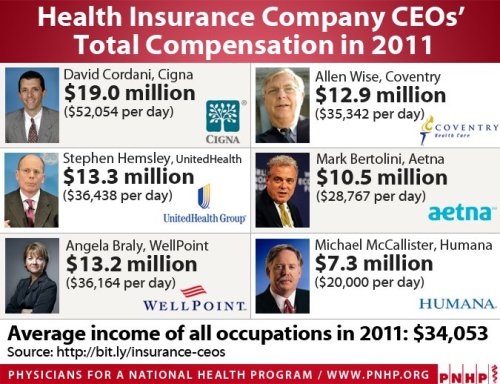
How many of you have ever heard of David Cordani, Allen Wise, or Angela Braley? Neither have I. But these people are CEOs of major nationwide health insurers, and they make more in a single day than most Americans do in an entire year. They rake in millions of health insurance premium dollars that could be used for health care for their customers. With so many folks struggling to afford health insurance, how can these folks sleep at night?

Fox News Dallas: Tort reformers promised a strong medical board, failed to deliver

Calling Fox News conservative is like calling the Atlantic a pond. Same for Dallas. But Texas is so anti-consumer that even Fox News in Dallas has reported on how tort reform doesn't work for ordinary Texans. In a followup news article, Fox News in Dallas aired a report on the Texas Medical Board. Texas legislators promised in 2003 when passing tort reform that the Texas Medical Board would beef up enforcement on bad doctors to make up for the caps on damages against those doctors. The report concluded that this didn't happen, and the Texas Medical Board's "delays, secrecy and leniency ends up costing patients and leaves a trail of devastation."

The report focused on three ordinary Texas families who were injured by doctors. In one case, the doctor had previously been "disciplined and ordered to pay $25,000 for prescribing controlled substances and dangerous drugs over the Internet." However, this doctor was permitted  to keep practicing, even though he didn't carry malpractice insurance, and he butchered two women during cosmetic procedures. One was left permanently disabled. The bad doctor's punishment? A temporary ban on performing those types of procedures. He is free to keep practicing medicine, and will be permitted to perform cosmetic operations in the future. How is this "keeping a tight rein on doctors"?

Other conclusions of the report include:

  • the Texas Medical Board conducts its reviews in secret, and even affected patients don't get to hear the doctor's side of the story;
  • since tort reform was enacted in 2003, complaints to the medical board have nearly doubled, but the Texas Medical Board only investigates 25% of the claims;
  • neither of the injured women in the story had health insurance, so the treatment they received after being injured by bad doctors was paid for by the taxpayers.

By and large, most doctors are good doctors. The rule of thumb is that 5% of doctors account for 50% of malpractice claims. Unfortunately, after tort reform was enacted, Texas legislators have fallen short on their promise to beef up enforcement against bad doctors. My Texas lawyer friends tell me that since there are limits on malpractice cases, they cannot invest the tens or hundreds of thousands of dollars necessary to take malpractice cases to trial. The patient loses.

In Arkansas, we don't have caps on damages. However, we expect this to be a fight in the Arkansas legislature in the upcoming session. Please write or call your local legislators and tell them you oppose tort reform, because it lets bad doctors off the hook! If they want proof, send them this link.

Fox News in Dallas reports that tort reform isn't working for Texans

Last week, the Fox News station in Dallas ran a lengthy segment on how tort reform in Texas is affecting ordinary Texas citizens. The clip provides hard data that debunks many of the myths of tort reform, including:

  • Texas has the highest percentage of uninsured residents of any state in the country;
  • Texas citizens pay more in healthcare premiums than the average American, so any alleged savings of tort reform haven't been passed on to consumers;
  • The number of new doctors in Texas as a percentage of population actually lags behind the rest of the country;
  • Texans who can't afford healthcare for disabled children rely on Medicaid, which is funded by taxpayers; and
  • Texans whose family members are injured or killed by incompentent doctors and nurses have nowhere to turn.

What the clip for yourself here.

Tort reform is bad for ordinary citizens who pay taxes, buy health insurance, and want to receive competent medical treatment. It is good for insurance companies, lobbyists, and other special interest groups who make money by shifting financial burdens to the government, instead of the parties responsible for causing financial harm to innocent people. Whose side do you want to be on?

Through a glass darkly

I am raising two small children. The oldest is three, and like all children, he is learning quickly at this age. He gets excited about new things —his bedtime story earlier this week turned into an hour-long Q&A where he wanted to know everything I know about electricity. Starting with Ben Franklin to the stuff from my electrical engineering classes (which was often sleep-inducing to me during summer school) to how the stop-motion video for his trains works (see below), he just listened with wide eyes and asked tons of questions. Even with my weekend chores and our play time, he wants to know the hows and whys when he's helping. (Surely most parents are familiar with the question "Why?" 30 times in a row.) He asks all kinds of questions without shame or a preconceived notion about what the answer should be.

As a parent, I'm glad that he's interested in knowing how things work, and that he gets excited about learning how to do those new things. The play is fun, but learning how the new activity works is important so he can play and learn and ask questions when I'm not around. Teach a man to fish, as they say. And it's not just my son — all little kids like learning new things.

Which brings us to the title line, which is from Corinthians and is something my wife really enjoys. It talks about how we did things differently as children, yet now our knowledge remains incomplete. We see through the glass darkly. We don't question things, nor do we seek out new knowledge in its own right like our kids do. That's why my three year old can pick up my phone and show me how to do things I never dreamed it would do. I suspect if we thought more like children do, for knowledge itself, the glass might be a little clearer.

The people we read about in history books are the ones who weren't afraid to ask questions and then look for the answers. Of course, you're not always going to get the right answers. In many instances, you're probably not even asking the right questions.

In my work as a patent lawyer and a trial lawyer dealing with medical issues, I run into two types of people. First, there are the people who question how a product or medical test works and how it could be made better. They may try new designs, tests, or treatments. Some might not work, but usually these people wind up figuring out a creative answer that is an improvement on their practices. These folks are the innovators, the reason we have advancement in technology, science, and medicine.

Second, there are people who are resistant to things they don't understand, or don't bother to learn about new things. I've seen businessmen refuse to consider that their tech business could be displaced by the next best thing. I've also seen doctors refuse to consider strong empirical evidence of effective new tests in favor of decades-old tests with half the diagnostic resolution. Without asking questions, how do these folks know what they're doing is ultimately helpful to their customers, clients, or patients? If only those who see through the glass darkly would merely begin with the question, what if I'm wrong?