CHANEY LAW FIRM BLOG

Subscribe to our Blog

The Fastest 40 Minutes in Basketball™

The Arkansas Razorbacks men's basketball team opened conference play at Georgia ranked No. 23. As fans of Hogs hoops will know, we haven't fared well on the road over the last decade. 

Last night, the Hogs won their first conference road opener in over half a decade. They did it with a strong performance in the first half by Bobby Portis, and an excellent shooting night (especially in the second half) from Alandise Harris, including a heat-check three-pointer that put the Hogs up for good. They eliminated a Georgia lead of six or seven points about halfway through the second half with a ferocious run. The announcers made reference to the fastest 40 minutes in basketball.

While searching for coverage about the game, I googled fastest 40 minutes in basketball. One of the first results to pop up was a Facebook page from Coach Mike Anderson's time at Missouri. The last post on the page was from March 8, 2011, at the end of Mizzou's regular season.

The usage of this phrase presents an interesting issue of trademark ownership. Usually, trademarks are owned by universities, not by coaches. So, had Mizzou trademarked THE FASTEST 40 MINUTES IN BASKETBALL when it hired Mike Anderson as coach, it would almost certainly not be using the mark anymore. As shown on the Facebook page, the last usage associated with Mizzou was almost 3 years ago. Under federal law, the trademark would be considered abandoned after three years of nonuse. 15 U.S.C. § 1127 ("Nonuse for 3 consecutive years shall be prima facie evidence of abandonment."); see also Ark. Code Ann. § 4-71-201 (abandonment occurs after 2 years). So, if the University of Missouri had registered the mark THE FASTEST 40 MINUTES IN BASKETBALL and was being horsey about giving it up to a conference opponent, after three years University of Arkansas could simply take it away — just like the Hogs did 17 times against Georgia last night.

But, you might ask, what's the "takeaway" for ordinary businesses? If you want to adopt a name for your product or service that was once used in a similar fashion by someone else, you'll need to wait at least 2–3 years before adopting your new mark.
Duck fever? Try duck gumbo...

One of the passions Don has passed down to his two sons is duck hunting. Fortunately for me, I also paid attention after holiday season duck hunts when Momma Chaney was in the kitchen. As a result, I probably like to cook more than I like duck hunting — especially when hot peppers are involved.

Duck huntin' lawyers

After opening weekend this season, we found ourselves with a couple dozen duck breasts left from a sizable group of hunters. This, my friends, is the perfect reason to make duck gumbo. Wait, you don't like duck because it's gamey? You sound like my wife. But even she had seconds and leftovers. Here's the "recipe".

Disclaimer: I've made gumbo so many times I don't follow a strict recipe, but instead work with a loose set of ingredients. The basic steps are: make a roux; fry up the Louisiana trinity; and add some broth, meat, and veggies. Artistic license is welcome. Anyway, here are the steps from my most recent batch (remember to read first and do your prep work!):

Bacon:

Cook at least a pound of bacon on a cookie sheet in the oven at 375 degrees until the fat is rendered and the bacon is pretty crispy. The bacon grease will pour easily out of the cookie sheet. Try not to eat all the bacon at once.

You can do this in a skillet, but the oven method yields the most grease with the least amount of burnt bacon, stirring, and cursing. Ask my Uncle Chuck what happened with his bacon at 5:30 am on Thanksgiving morning this year, and you'll know what I'm talking about.

Roux:

1/2 cup bacon grease
1/2 cup flour (wheat, rice, arrowroot, whatever your fancy, the Cajuns weren't/aren't picky)

Heat the oil in the biggest dutch oven you can find until a drop of water sizzles in the bottom. You want the heat pretty high but not full blast. Slowly stir in the flour until it's evenly mixed. You want enough flour so that the grease isn't watery, but not so much that the roux looks grainy and stacks up into little mounds; nice, small, quickly-filling tracks should follow your whisk. It will look something like this when you start:

Keep stirring steadily as the flour darkens (you don't have a whole lot of time here to chop up the veggies for the next step, so do that before you start the roux). It will take a while, but your patience will be rewarded. The darker the roux, the richer the flavor. A good friend once told me that a good gumbo roux should be the color of a dirty penny; I've also heard comparisons to Hershey's chocolate. Here's where I stopped:

Once the roux is good and brown, add the veggies. I usually add:

1 head celery, diced (6-9 stalks, including all but the most white little ones, keeping the leafy parts)
2 large onions, diced
Enough diced peppers to provide about the same bulk as the celery (bell, jalapeno, poblano — we grow peppers and use whatever's available, and you can remove the pith to minimize heat for the faint of heart)
1 head garlic, minced

The addition veggies to roux creates what is undoubtedly my favorite smell in the entire world. You get something that looks like this:

Cook the veggies for a little bit, stirring regularly to keep the bottom from sticking. Once the onions start to turn clear, add some liquid to the party. I usually use a quart of chicken or beef broth plus enough beer/water to come most of the way up the pan, with the understanding that I'll cook a lot of the water out over the next couple of hours. It looks like this:

Once you've added the liquid, make sure to stir well to dissolve all the nicely browned flour.

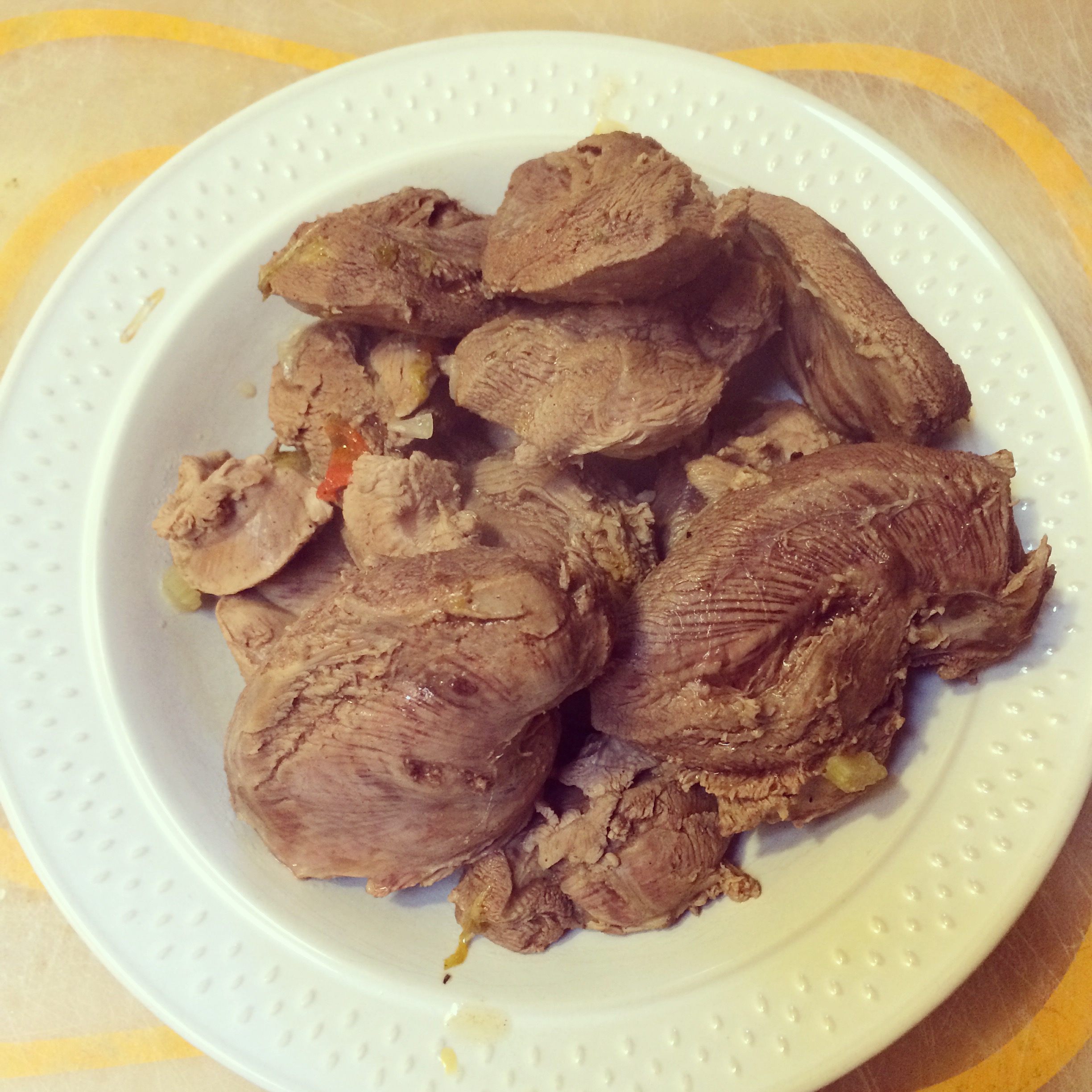
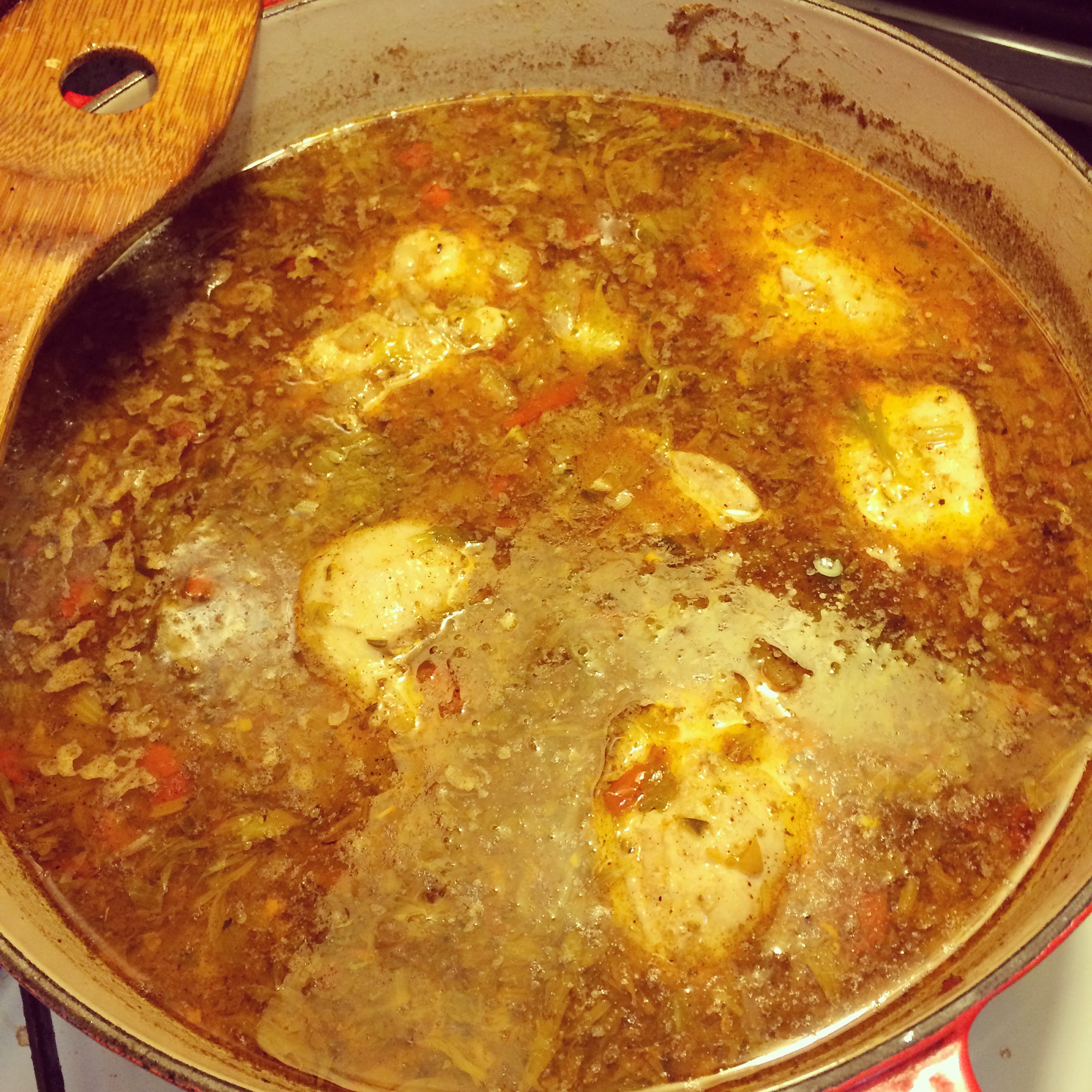
The next step, usually, is to poach some form of meat. Heat the broth until it's boiling and toss some meat in. You can use whatever you have on hand. I've used sausage, bacon, chicken, turkey, duck, crab, oysters, shrimp, redfish, venison, and beef in gumbo, and I'm probably missing a few. Traditionally gumbo was a melting pot type of dish. I usually don't add seafood until the gumbo's almost done, but you do want to get other types of meat cooked at this step while the gumbo is a thin broth. Below are photos of poaching chicken and duck:

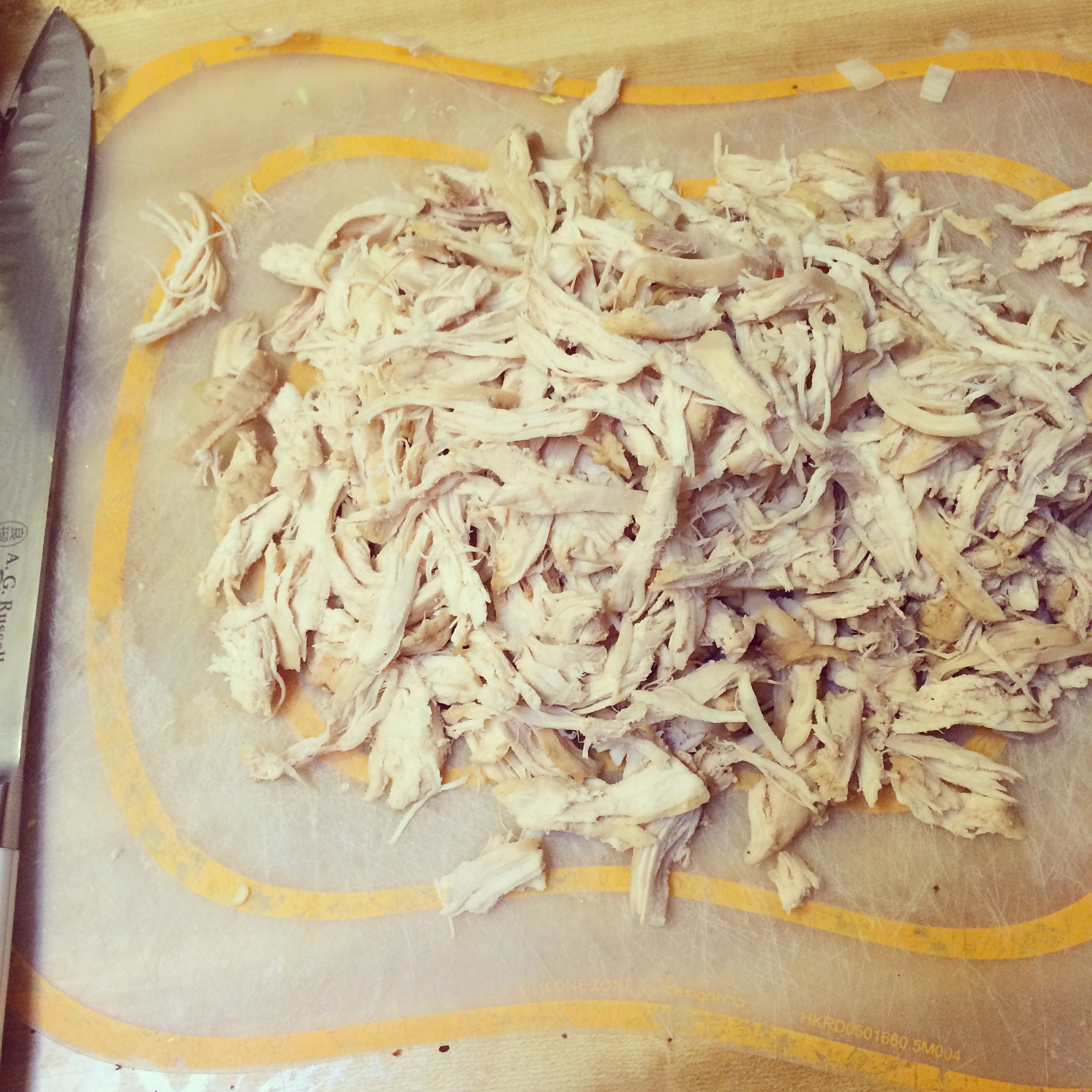
This gumbo has about 3 pounds of chicken and about 4 pounds of duck breasts. I like to shred chicken into long, thin strips, which has a similar visual appearance to using crab in gumbo. The duck I dice finely, as we shoot our own duck and the only one who likes steel shot in gumbo is your dentist.

One of the things I remember from being a kid is a catfish restaurant named Kreg's. I once heard the secret ingredient was the catfish, which was rinsed in ice water four times before being breaded and fried. Whatever they did the catfish was great.

I almost always process duck at least twice to remove the gamey flavor that keeps my wife from eating it (you would think an oysterman's granddaughter would like duck). For instance, when I grill duck I'll slice it first, brine the slices 4 times in cold water for about 10-15 minutes apiece, and then wrap in bacon and a pepper slice. That process provides a beefy but not gamey taste.

When cooking duck in gumbo, I brine whole breasts several times before I poach them. Something I recently started doing is frying the finely diced, poached duck in bacon grease after I poach it. It gives the small pieces of duck great texture and helps with the gamey flavor. My wife was impressed at this batch of gumbo.

Once you've got your meat chopped up and added back to the broth, it's time to add a large can (28 oz or so) of whole peeled tomatoes, a large can (same size) of diced tomatoes, and a tablespoon or two of tomato paste. For spices, I usually add a couple of bay leaves, a palmful each of oregano and thyme, a generous shake of cayenne pepper, about 1/8 cup of Worchestershire sauce, and a generous grind out of a pepper mill (I add salt at the end, since you're cooking off a bunch of water during the process). I might add some paprika for color. This is all to taste; I quit measuring ingredients for gumbo as a teenager, and instead tried to make it taste like the kind Momma made out of the Southern Living cookbook.

Once you add all this stuff, you'll get to a point where the pot's almost full. If it's not, add some water until it looks like this:

Simmer the gumbo down a long while over very low heat. Go watch a quarter of a football game, train the new puppy, take a walk with the kids. The longer, the better.

Once it's getting close to time to eat, you can add a pound or two of okra if you like, although one of my northern Louisiana friends complains about that (Kendal also uses roux from a jar, so there's a credibility issue to consider). If you're using seafood, now's the time to add it as well. You want to start your rice and cornbread about this time as well so everything's done at the same time. You'll get a nice, thick, soupy result that looks like this:

We serve our gumbo with rice and cornbread. Here's the finished product:

Duck hunting is one of my favorite ways to enjoy the outdoors — but I find cooking gumbo from the result of the hunt even more relaxing. I hope you enjoy it as much as I do. Cheers.

Trademarks and Confusion – What is an Overlapping Market?

I saw a good writeup from Dennis Crouch of Patently-O, an award-winning patent law blog. Professor Crouch's article talks about the key requirement for a trademark registration — the applied-for mark can't be likely to cause confusion with a previously-registered trademark. This is the same test juries must apply in trademark infringement cases. 

Most courts use a 6- or 8-part test to determine whether confusion is likely. You may be surprised to learn that actual confusion is not required and is usually pretty far down the list.

In Professor Crouch's article, he discusses a recent case involving an application for the word TakeTEN, which is used for a hospital's 10-day inpatient "lifestyle shift" program (for things like tobacco use, diabetes, weight control, etc.). The application was rejected due to a likelihood of confusion with Take 10!, a registered trademark used to encourage kids to have 10-minute classroom intervals involving physical activity. The two marks appear below:


On appeal, the rejection was reversed because the trademark examiner didn't meet the required burden of substantial proof that the two marks were likely to be confused with one another. The appeals court found that the services were sufficiently different, even though both owners advertise on the Internet. Did the court get it right? Do you think these two uses are likely to be confused with one another?

Trademark law invariably involves judgment calls over whether two names or symbols are likely to be confused with one another, taking into account things like relevant markets; similarity in sight, sound, and meaning; industry significance of all or portions of the two marks; intent; instances of actual confusion; and the type of product and its conditions of purchase. These factors are discussed in perhaps my favorite trademark infringement case, Gaston's White River Resort v. Rush.

It's important to select a trademark lawyer with experience in both registration and infringement matters to assist you in the trademark procurement process — experience helps a lawyer predict what a trademark examiner or jury would do with any given case.

The Power of Perseverance

All of the Chaneys except my wife, who's from Virginia, are University of Arkansas alumni. Those in Razorback country know well the struggles of our football team. For those that don't, here's a recap:

  • 2010 – BCS appearance in the Sugar Bowl, where we were defeated by a bunch of tattooed (and ineligible) players from Ohio State. Bobby Petrino's third year. The game was close, and we all looked forward to Petrino's recruits maturing.
  • 2011 – A dominating Cotton Bowl victory over K-State in Bobby Petrino's third year. 10 wins on the season. Truly, a cause for celebration and optimism.
  • 2012 – Ah, 2012. Truly, this was a year to forget. April Fool's Day brought a headline worthy of the day but, alas, it was no joke. Coach Petrino had a wreck on his Hog-red Harley with a woman not his wife on the back. He then lied about it to his boss, repeatedly, who fired him during a press conference televised on national TV. A bankrupt interim coach took over for the season. 3 players were charged before the season started with nine felonies EACH, making the Hogs the winner of the 2012 Fulmer Cup (an offseason tally of criminality, so not something you want to be winning). Still, we carried a top-10 ranking into the season, but many fans were uneasy. They proved to be right, as a lowly directional school in Louisiana-Monroe beat us in overtime the second game of the season and we tumbled out of the rankings. We finished 4-8. One of the four was against Kentucky in what would be the last SEC win for a long while.
  • 2013 – Athletic Director Jeff Long hired Bret Bielema to take over the program. The fanbase collectively said, "Huh"? Reactions were of two varieties when fans learned of his track record at Wisconsin (three consecutive Rose Bowl appearances, but no wins in two coaching appearances). Some fans thought he'd be great at putting together a running team like he had at Wisconsin with Russell Wilson, who won the 2014 Super Bowl at Seattle. Other fans thought he was only good playing with the players of his mentor, Barry Alvarez. The season was a long one, ending with a 3-9 record and 0 wins in conference play.
  • 2014 – A long offseason saw quarterback Brandon Allen's name besmirched daily on talk radio and his truck torched before the season started. The schedule was brutal. Most of Petrino's recruits were gone, and the ones that stayed were losing jobs to more talented youngsters. Every SEC school played through last weekend ranked in the top 17, and five of six were in the top 10 at game time. The season picked up where last season left off — a slew of conference losses. There were bright spots, to be sure, in dominating non-conference wins over inferior opponents and close games against superior opponents.

This 5-year history brings us to the present. Last weekend brought LSU to town, a team that is usually in the top two of the SEC West. LSU was ranked 17. Arkansas was on a 17-game SEC losing streak. Arkansas dominated from start to finishing, winning 17-0. The 17-degree windchill* didn't stop jubilant fans from rushing the field to celebrate with the players.

Who has been kicked in the teeth 17 times in a row by their peers? How does that affect one's psyche? Most folks would really be down on themselves after such a long period without success. It really says something for the leadership abilities of Coach Bielema to keep his players motivated during such a long losing streak. The players haven't quit this season and have played most teams close with the exception of Georgia. They have broken the cycle. #WPS

There is a corollary to trial work. People like me who represent individuals against insurance companies and other big corporations often face repetitive and distasteful behavior. A common tactic of insurance company lawyers is to ask questions to clients about things that happened 17 years ago, then try to find a piece of paper from a doctor to make the client out to be a liar. For example: "Have you ever been treated for neck pain or headaches?" If you went to the doctor 17 years ago after a waterskiing fall with headaches and neck pain, you better believe the insurance company will point to it in denying your claim. Nevermind the hypocrisy of arguing, on one hand, that soft-tissue injuries should heal within 6-8 weeks, but, on the other hand, the treatment 17 years ago was to the same body part so the defendant couldn't have caused the injury.

The toughest clients are the ones willing to take their case to a jury of their peers. A jury trial is grueling on clients in its own right: everything in the client's life is placed under a microscope — work history, social life, tax returns. However, a jury is sometimes the only way clients are ever able to persevere after a life-altering injury. A jury has the power to make right all the things that went wrong for the client. The jury is the difference between what could have been, and what is.

*I may or may not have made the windchill up, but it was in the 20s during the game.

Nathan selected to Super Lawyers for 4th year straight

Nathan was selected as one of Super Lawyers’ Rising Stars for 2014. You can view the 2014 Mid_South Super Lawyers Magazine online here.

Super Lawyers is a nationwide “rating service of outstanding lawyers from more than 70 practice areas who have attained a high-degree of peer recognition and  professional achievement. The selection process is multi-phased and  includes independent research, peer nominations and peer evaluations.

Super Lawyers magazine features the list and profiles of selected attorneys and is distributed to attorneys in the state or region and the ABA-accredited law school libraries. Super Lawyers is also published as a special section in leading city and regional magazines across the country.”