CHANEY LAW FIRM BLOG

Subscribe to our Blog

Chaney Firm team members accept awards for contributions to community

The Arkadelphia Alliance and Area Chamber of Commerce held its annual award banquet on March 1. Cindy Jackson, a Chaney Firm team member, was recognized with the Volunteer of the Year award for her tireless efforts for the Clark County Charitable Health Service. Cindy helped establish the Health Service, a donation-run nonprofit organization which helps more than 150 uninsured Clark County residents obtain medical attention through local providers. Cindy personally staffs the clinic two days a week. For more information about the Clark County Charitable Health Service, read an article published by our local paper here. Donations to help fund the service can be sent to Southern Financial Partners, 615 Main St., Arkadelphia, AR 71923 with the check marked “Clark County Charitable Health Service.”

Leah Sexton, another Chaney Firm team member, is the president-elect of the local chapter of Junior Auxillary. She was on hand for the awards banquet to help accept the Volunteer Organization of the Year award to Junior Auxillary. As a few examples of JA's contributions to our community, the annual Angel Tree drive raises enough money to provide clothing and toys to over 500 local children each winter. JA also throws a charity ball each spring to raise money for other community projects, including backpacks for schoolchildren. To donate, send checks to Junior Auxiliary of Arkadelphia, to P.O. Box 565, Arkadelphia, AR 71923.

Congratulations to Cindy and Leah! We are proud of you!

Help two Arkansas soldiers denied Purple Hearts after being shot by jihadist

UPDATE (4/16/2015): After several years and a change in legislation regarding the way Purple Hearts are awarded led by Arkansas Congressmen, Private Long and Private Ezeagwula were awarded the Purple Heart. You can read more coverage here.

A friend and colleague of ours is representing the families of soldiers who were shot by a Yemeni-trained terrorist in Little Rock in 2009. This trial lawyer is representing the families pro bono (without pay) because the Department of Defense is denying a purple heart to these soldiers, and this lawyer is trying to get the federal government to change its mind. Please support these military families by emailing or Facebooking your congressional team. Here is the contact information for my district:

Mike Ross' Facebook page
John Boozman's Facebook page
Mark Pryor's email contact form

Here is Channel 7's news coverage of the event:


Now, here is the letter from my friend and colleague, Tre' Kitchens:

Dear Mates,

I am proud to represent the families of the two soldiers who where gunned down by a terrorist outside the Army Recruiting Center in Little Rock on 6/1/09. Private Long lost his life and Private Ezeagwula still carries a bullet on his spine and will for the rest of his life.

The man who shot them was a Muslim terrorist who had traveled to Yemen from the US for terrorist training, was arrested in Yemen and interviewed by the FBI while in a Yemen jail, brought back to this country and interviewed again by the FBI, was able to walk into his local Wal-Mart and purchase a gun legally, and then shot these two soldiers as declared act of war for American "aggression" in the mid-east. He entered a guilty plea in State Court and the Feds never charged him.

The federal government has decided that these two soldiers were the victims of a drive by shooting, a "street crime", and not a terrorist act. Therefore, they are not entitled to a Purple Heart or other medal. This is important to the memory of Private Long who comes from a military family (mother, father, brother, grandfather, uncles, have all served or are serving our Country), and the continued care and treatment of Private Ezeagwula at the VA.

Tomorrow night on Channel 7, at 10, their story will air. I encourage you all to watch. Private Long's father, a life long Marine, has testified before Congress on this issue. Not recognizing these young men is wrong. It should be fixed.

If you know your Congressman or Senator, or anyone else in Washington, I encourage you to make a call. If you need more information let me know.

I am representing these families without a fee. I am doing it because its right and I anticipate that most of my friends on this list would do the same thing, and probably do a better job. I am grateful I work with someone who allows me to do these kind of things when it really matters, and that I'm part of an organization that cares.
Thanks.

Tre' Kitchens

The Brad Hendricks Law Firm
(501) 221-0444

Arkansas Law Review publishes article authored by Nathan

ark_l_r_cover.jpg

The Arkansas Law Review published an article in its Winter 2012 edition authored by Nathan Chaney. The article is entitled "A Survey of Bad Faith Insurance Tort Cases in Arkansas" and contains a summary of hundreds of bad faith cases decided by Arkansas state and federal courts.

Bad faith cases are unique to insurance companies. All contracts have an 'implied duty of good faith,' but the only time someone can sue for a breach of this duty is when an insurance company does the breaching. Since insurance companies usually dictate policy terms, insurance policies are considered 'contracts of adhesion' that consumers can either sign or reject as-is, and cannot negotiate terms. The consumer's absence of an ability to negotiate is why insurers are held to a higher 'bad faith' standard.

There are two types of bad faith. The first type is called 'third party bad faith.' When an insurance company must defend someone (such as when the policyholder causes a wreck), the insurance company owes a 'fiduciary duty' (the highest legal duty owed by one to another) to the insured. That duty requires the insurance company to settle the case if it has an opportunity to do so and settlement would be reasonable under the circumstances. If it does not settle in this situation, it can be liable for negligent refusal to settle or outright bad faith.

The other type of bad faith is 'first party bad faith.' That involves a situation where an insured makes a claim with the insurance company and the insurance company treats the insured with ill will, hatred, or outright malice. First party bad faith usually arises in one of two circumstances: (1) the insurance company denies the claim on the merits without conducting a proper investigation, or (2) the insurance denies the claim despite facts in the file showing that the claim should be paid.

In a nutshell, insurance companies are supposed to give insureds the benefit of the doubt in the absence of hard evidence that they shouldn't. When they don't, they commit bad faith.

The map is not the territory

As a Boy Scout, orienteering was one of the merit badges I earned before I became an Eagle Scout. It involved my scout buddies and me using topographic maps to plot cross-country courses. Several of these trips took place walking through the pine forests of DeGray Lake, and we had to avoid getting lost on the wrong fingers of the lake. Even with our best efforts at reading the map, a time or two we wound up at the end of one of the wrong fingers. While we had a map, our twelve-year-old selves couldn't always translate what was on the map into what we saw in the dense forest in front of us.

On a later trip to rehash what we'd learned, our scoutmaster guided us along the route we were supposed to have taken. (He even gave us one opportunity to drop our packs. Knowing that he was a prankster, no one took him up on it — we were right not to, because we took a different route back). When we got to the spot where we took a wrong turn and wound up on the wrong finger of the lake, he explained to us how we'd gone wrong with our mapreading. In our case, it was better to have a guide who'd already been down this path, rather than a map drawn on a piece of paper to try and guide ourselves.

Even later in life, I continue to be an outdoorsman. When I lived in Northwest Arkansas, my favorite place to go was the Kings River (it still is, when I get up to that part of the country). One of the most breathtaking sites on this river is Kings River Falls. The Arkansas Natural Heritage Commission has even established a Kings River Falls Natural Area in Madison County near St. Paul for ready access to the falls.

The map above shows the location of Kings River Falls, but you really can't tell anything about the beauty of the place from the map alone. You just know where it is. To see the real beauty, you have to get out into the territory and walk down the riverbank next to the walls built by Scottish settlers from rocks pulled from the jagged bluffs of the Ozark Mountains. You have to experience the rushing water for yourselves. I've done this on numerous occasions, and I'll share one with you below:

The map of Kings River Falls tells nothing about the icy-cold water numbing my toes, the freight-train roar of 10,000 cubic feet of water cascading through a tiny gorge each second, the sight of man-sized logs tossing about in 6-foot standing waves. Nor does a map tell anything about the most vivid memory I have: the wonderful scent of pure, clean, rich, fresh earth. I had to be in the territory to experience all these things.

Those early outdoor lessons also help in the practice of law. Most times when our personal injury cases go to court, a jury must chose between two stories: the treating doctor's story or the professional defense witness' story. The treating doctor will have taken a history, performed a medical examination, reviewed pertinent records, evaluated the impact of any preexisting conditions, assessed the patient's complaints of pain, and actually treated the patient over several years. In contrast, the professional defense witness often will have only read records for an hour or two.

The treating doctor is a guide who knows the territory. The professional defense witness is just some guy who has a map and — without having seen the territory — could very well be lost in the woods.

Child safety tips — window blinds

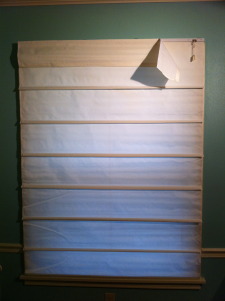
I've got a room in my house that is somewhat chilly around the windows. To minimize the heat loss during the winter, I recently installed some Roman shades over each window frame for (hopefully) added insulation. In reading the directions, I noticed that blind manufacturers now suggest trimming the pull cords as short as possible so children can't easily reach the cords. They also suggest separating each one of the pull cords from all the others so the cords won't form loops that a child could get his or her head stuck in.

Since I've got small children, I followed the recommendations of the manufacturer and trimmed the cords. I looked around the house at other blinds and noticed that older blinds in the house don't have separate pull cords — instead, they are all knotted together at the bottom. This poses the danger the manufacturer of my new Roman shade warned about, so I trimmed the remaining blinds in the house and separated the cords.

I hope this little safety tip helps those of you with children and grandchildren.