CHANEY LAW FIRM BLOG

Subscribe to our Blog

El Dorado man earns fishing yo-yo patent

A client of mine from El Dorado recently earned a patent on an improvement he invented for fishing yo-yos. (For those of you unfamiliar with yo-yos, check out this ESPN article, which was cited in the patent application to educate the patent examiner).

The new yo-yo adds a battery and a switch on the back of the yo-yo. The front part of the yo-yo is a spool that has an integrated trigger. The yo-yo and switch are baited and set. When a fish strikes, the spool begins turning to reel in the fish. The turning action of the spool also turns the trigger, which trips the switch and signals the fisherman that he has caught a fish. The switch is most often a light, but can also be a radio signal.

An optional feature is to have a light shining down on the water when the yo-yo is set. This has two advantages: (1) the light attracts bugs, which attract small fish, which attract bigger fish; and (2) the fisherman can see where his yo-yos are at night. When a fish strikes, the switch turns out the light shining on the water and activates another, different-colored light to alert the fisherman.

Congratulations to Mr. Carelock on his new patent!
Patent Rocket Docket stays in the Eastern District of Texas

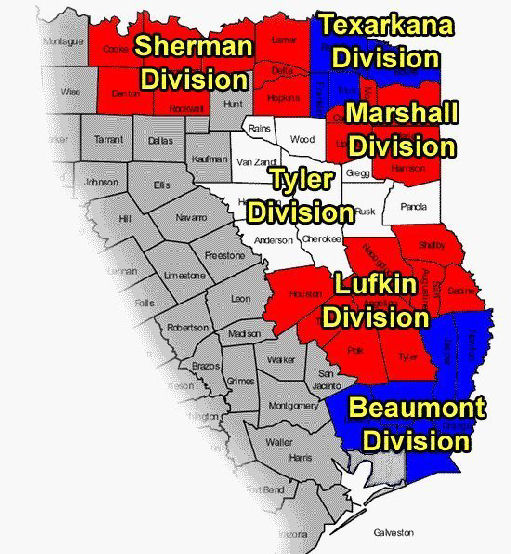
In 2010, the Eastern District of Texas remained the undisputed Rocket Docket for patent cases. According to a recent article, 299 patent cases were filed in the E.D. Tex. in 2010. That’s 44 more cases than the next most popular district in Delaware. Even more stunning, however, is the number of defendants in the E.D. Tex.: nearly 4,000, compared with under 1,000 for the next most popular district.

The E.D. Tex. remains a popular district because the docket moves quickly (hence the nickname) and because the judges are perceived as familiar with patent cases. In litigation, plaintiffs generally want to move quickly, while defendants wish to slow down the process. Motions to transfer venue are a way to slow down the process by (1) filing the motion in the first place, and (2) transferring the case to a slower, less patent-savvy district court.

The Federal Circuit Court of Appeals, which hears all patent appeals, continues to review many cases involving requests for transfer of venue. Some of those cases have attempted to make it easier for Defendants to secure a transfer of venue to a more convenient location. Accordingly, it remains to be seen whether the E.D. Tex. will continue to be the nation’s Rocket Docket for patent cases.

Patent pendency dashboard

pendency.jpg

Last fall, the U.S. Patent & Trademark Office (“USPTO”) unveiled its Data Visualization Center, which is a real-time reporting tool showing the USPTO’s performance in examining patent applications.

The Patent Dashboard feature shows several metrics for pending patent applications. The USPTO currently issues its first substantive action on the average new patent application 25.3 months after the filing date, and is currently issuing patents a little less than 3 years after the filing date.

Over the last several months, the USPTO has added staff and made a concerted effort to reduce the application backlog. The result has been a reduction in the total pendency time for new applications.

These figures are great for people (especially new clients) who are thinking about filing a new patent application. Once an application is filed, the USPTO will provide an estimate of time to the first office action for that particular application. Clients who want to know this information can call and ask for this estimate, which we can retrieve quickly through the USPTO’s Private PAIR system.

Send in your Clark County retail liquor permit applications

The reality of liquor stores in Clark County, and the jobs and tax revenue they bring, is close at hand. Today’s the first day of a 60-day window when the ABC will be accepting applications for new retail liquor permits. Five permits will be issued in the county, which is keyed off the new 2010 census figure of 22,995.

June 6 is the final deadline. The application is fairly involved, so anyone who’s interested should get started early. Any deficiencies can be corrected during the 60-day window.

After June 6, the ABC will invite everyone with a completed application to Little Rock for two drawings. The first drawing will determine position for the second drawing (think of it as a qualifying race). The second drawing will determine the order in which the ABC will examine completed applications. Anyone in the top five of the second drawing has an excellent chance of getting one of the five retail liquor permits.

The application fee runs $2,000, half of which the ABC will return to applicants who do not receive a permit.

Of course, I’d love to help anyone with the application process. Feel free to give me a call anytime.

Is big pharma in trouble as patents expire?

The New York Times published an article earlier this month on the financial problems some drug companies are facing due to the expiration of the patents on blockbuster drugs. Once a patent expires, competitors can begin selling generic drugs at a fraction of the cost. These generics eat into the profits of the name-brand, patented drug.

Should we feel sorry for the drug companies? Consider three things: first, the article reports that “Americans fueled the research engine, spending much more per capita on prescriptions than in any other nation, and paying the highest prices for prescribed medicines.” Second, the pharmaceutical companies have billions in cash reserves, much of that borne on the back of regular Americans. And third, U.S. law gives pharmaceutical companies up to 5 additional years of exclusive use beyond the term all other patent owners get. Ordinary Americans have struggled through the latest recession, and few of us have $20 billion in cash lying around to get us through the rough times. I see families every day who have to choose between paying a light bill or buying much-needed prescription medications. So, pardon me if I don’t feel too sorry for the drug companies that gouge American families for hundreds or thousands of dollars a month for medication yet virtually give that same medication away to Canadian and European citizens.

With all the billions the drug companies have lying around, they have plenty to spend lobbying Congress to pay for expensive drugs. Problem is, Congress helped fund the development of many of these drugs. It seems like to me that federal deficits could be substantially reduced if we did two things. First, we could invoke the Bayh-Dole Act so the government pays less for prescription drugs for which it sponsored research. And two, we could reduce the patent terms for prescription drugs so they don’t get preferential treatment. These things will be tough given big pharma’s lobbying power, but they would help get our government out of debt and help the wallets of ordinary Americans.